What AI can and cannot do for early screening
The interesting question is not whether a model can spot a pattern. It is what happens in the eleven months after nobody spots anything at all.
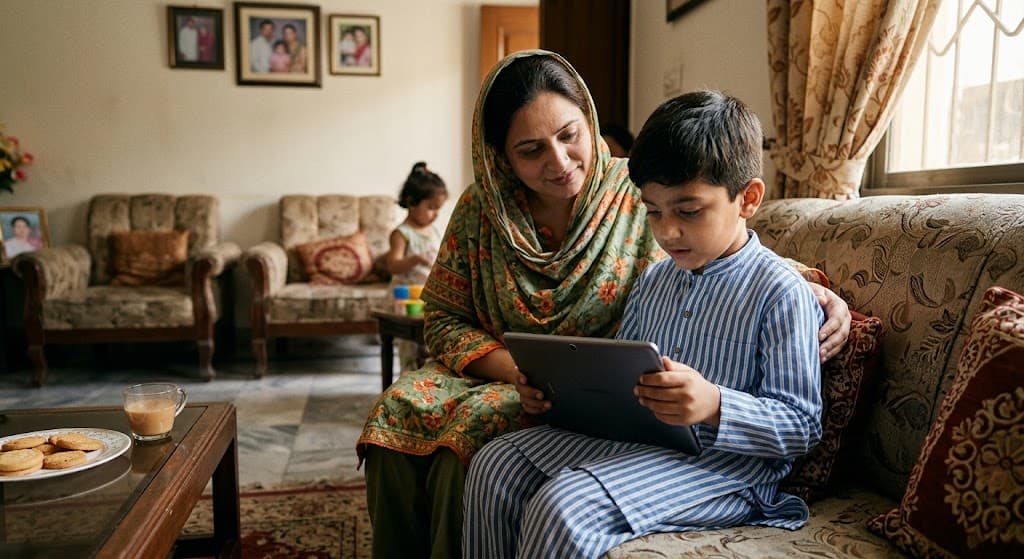
Every few months another claim arrives: an algorithm that detects autism from a home video, a voice sample, a pattern of eye movement. Some of that work is serious. Very little of it is ready for a classroom in Lahore, and the reason is not the quality of the models.
It helps to separate two problems. The first is analytical: given a set of observations about a child, how accurately can we identify a likely need? The second is one of coverage: how many children are observed by anyone trained to look in the first place? Nearly all attention goes to the first. In Pakistan, the binding constraint is the second. Improving detection accuracy from 84 to 89 per cent solves a problem most families never get close enough to have.
Where it genuinely helps
The useful applications are quieter than the headlines. Screening tools like EAST ask a parent or teacher to run a series of structured activities and record what happens. Consistency is the weak point: the same child, screened by two adults, can produce two different pictures. Automated scoring of time taken, wrong attempts and incorrect answers removes some of that variance without asking anything more of the adult in the room.
Adaptation is the second. Rawaan already adjusts difficulty to a child's level in real time, and doing that well is a modelling problem — one where a wrong answer costs a child a slightly boring afternoon rather than a misdiagnosis. Translation and localisation is a third: getting good Urdu into a tool is expensive, and this is a place where the technology has genuinely lowered the cost.
A model that tells a family something is wrong, in a country where the next appointment is four hours away and six months out, has not helped anyone.
Where we are cautious
Three things concern us. Most published models are trained on Western datasets, and behaviour that reads as a marker in one setting can be ordinary in another. Children's data carries obligations that a research prototype rarely thinks through. And a confident automated result, handed to a family with no pathway behind it, does harm — it converts uncertainty into fear without converting it into action.
Our position is that these tools should assist the adult in the room rather than replace them, and should be tested the way everything else we build is tested: in real classrooms and clinics, with people who will tell us plainly when it does not work.
50+ clinically viable activities that let a parent or teacher screen a preschooler, with results a clinician can act on.
About EAST